

Approaching Passover, the main theme is to rid your household of leavened bread—meaning the type that we normally eat—in all of its varieties, from loaves to crumbs and any mixtures in between. It is a huge operation because throughout the year those crumbs accumulate in the most unexpected places. Everyone has a story of a stale piece of bread found in an infrequently worn jacket. That’s a disaster in the making and as great as the wonder of what it was doing there, is the sense of gratitude that it was found in time. Often, the end result of this crazy Jewish spring cleaning is that the participants arrive at the table on the first night of Passover totally exhausted, just when they are called upon to tell the story of the Exodus from Egypt that lasts a few hours, in addition to being required to drink four cups of wine during the telling. Tap your head with one hand and rub circles on your belly with the other.
Not surprisingly with the Jews, there is a mystical correlation to this sweeping of crumbs from the kitchen floor, and that is to sweep the crumbs from our souls, to throw out the fat loaves of bread suffocating our hearts and preventing us from drawing closer to our Creator. It is the work of the heart, and it needs to be done in parallel with the work of the vacuum cleaner. This year I put myself to perform this inner cleaning to the best of my ability.
This was fitting for one who has taken on serious Jewish study in his retirement. First and foremost, serious Jewish study means one-on-one study with a chavruta, or study partner. Finding the right chavruta is important. Ideally, you want someone who is more knowledgeable than oneself so to be “pulled up.” But not too much more knowledgeable, so as not to find oneself unable to add anything to the studying that is of value to your partner. When you find the right balance is where the magic begins. My chavruta is a few years older than me, originally from Nir Galim, the moshav founded by Hungarian religious Zionist survivors of the Holocaust near Ashdod.
The mystery is what my chavruta sees in me. I have had some learning over the years, but compared to how we learn today, I came to our partnership woefully ill prepared. What that meant when we started about a year and a half ago was that I needed to prepare myself before our study sessions. Something like an hour preparation for a two-hour study session. This, along with our evening Talmud group and various classes on Jewish thought brought my daily study load to about five hours. For over a year I had felt that it was enough, that I needn’t demand of myself anything more.
That is, until just before this Passover, when I searched my soul for superfluous leaven. I found it in abundance. Mostly it involved the internal workings of the soul—isn’t that a never-ending fight? —but there was one actionable crust of mouldy bread that was easily rectified. Review. All this studying was wonderful for the soul, but without extensive review, it’s an in-and-out burger. True, something of the material is always retained, but there is only one test in Jewish learning: Can you pass it on? Having a general idea in your mind about some subject matter is far from being able to explain that subject matter to your chavruta, or for that matter, to your child, as the Torah commands.
I made the decision to begin reviewing, and that meant blocking out another part of my day. I would begin slowly, reviewing for only one hour a day. Since Passover was close, I decided that this new arrangement could wait a week until after the holiday. And that small deferment, that mañana moment, would become for me the crustiest and mouldiest morsel of leaven by far. That’s how I came to see it.
The great unravelling began at the very end of the first day of Passover. I hurried to get to synagogue for the evening prayer that would see off the first day of the holiday. After I had rounded the corner near my house and on to the straight stretch that led to synagogue, I noticed that I had a silent shadow. It was my younger daughter’s youngest child, a precocious six-and-a-half-year-old boy. He knew that if he remained undetected long enough that I would not have time to take him back and still make prayer on time. I paused and said his name. He was a boy that needed tending-to in the synagogue and I could not do that while I was praying. Before I could object he said: “Saba (Grandpa), I want to pray.” So off to prayer it was, together.
We arrived a few minutes early, and that suited me; I would have time to explain to him the importance of behaving himself. As I bent down to speak to his ear, I was stopped by him holding the prayer book up for me to show him where the evening prayer was to be found. This was him wanting to show me something. I opened his book and showed him. He nodded his head in thanks and turned to the book, ready to begin. This boy had moved beyond being a troublemaker, and I had not noticed. I was impressed, and proud.
The prayer leader approached the prayer stand and…Incoming Missile Alert. It was not a complete surprise, though this was towards the end of a major round of fighting, a round in which we found our area of Israel relatively unaffected. Still, knowing the drill, we all began to turn and walk towards the Beit Midrash near the entrance of the synagogue where I studied every morning, a study room that seconded as our bomb shelter. Since I sat near the front of the synagogue, farthest from the shelter, I knew that there was no point in rushing—I had the entire congregation in line in front of me. Calm, collected, and responsible as instructed by the Home Command, we proceeded slowly to the shelter.
Then I heard a voice, filled with terror:
“Oh no!”
It was my grandson. At the sound of the siren, he had darted towards the shelter with my approval, only to be confronted with a wall of grownups as they entered the narrow passage to the shelter. He could not find a way through. He was used to rushing to the bomb shelter at his home, because at the beginning of this round of fighting, the missiles were flying from Gaza, and the warning time was in seconds, not minutes. His neighbourhood received more sirens and explosions than anywhere in Israel at that time. Now, though following the rules, he found himself exposed, separated from his grandfather, and lost in a forest of grownup’s backsides. I had to get to him.
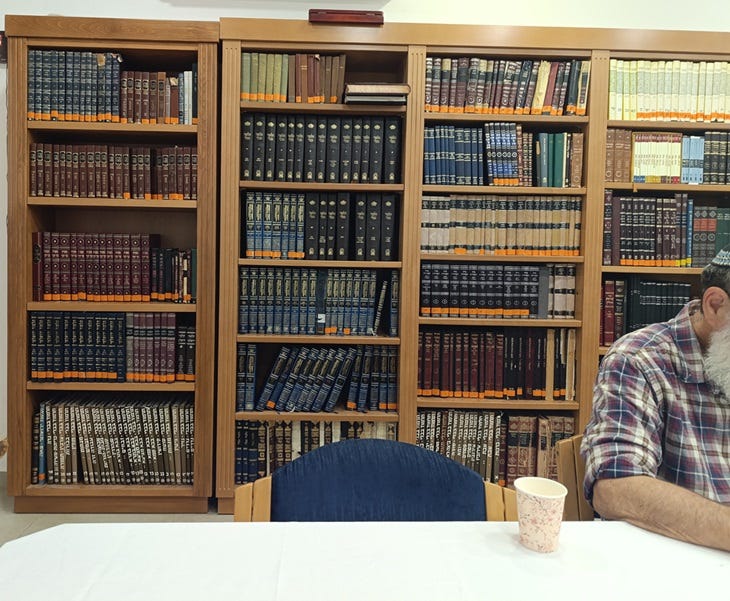
As politely as possible, and with a friendly shove when necessary, I finally reached him. I raised him in my arms and held him tight. He was trembling. Now that he was above the forest I turned to and fro so that he could see the traffic jam and that there had not been a conspiracy to hold him back. He held me tight like his mother used to hold me, so tight that both my arms were free, and we entered the shelter, I found a chair with its back pulled up to a bookshelf and set him down upon it. We were delighted to find that standing right next to the chair was my grandson’s home room teacher from school.
The heavy door was slammed shut like an exclamation mark on the holiday. The night before we had said “In every generation they rise up to exterminate us,” and here we were, awaiting the arrival of a warhead from a land whose people have vowed for the last fifty years to exterminate us. We were calm, in an Israeli way, because we were sheltered. In that self-enforced calmness, I watched my grandson and my mind drifted. The bookshelf he was now leaning into from his chair was our Talmud bookshelf. This is the very same shelf that I see every morning when I look up from my studies past the head of my chavruta. The sea of the Talmud, wherein lie the secrets of the Jews, the heart and soul of Judaism, and as such, the eternal target of ignorant antisemitism. Of all the facets of Torah learning, it is still the hardest for me, but as a reward for my daily wrestling with it, I am now confident that with a few thousand more hours of study I will master it. In other words, whether I was having a good day at study or not, one look at that wall of wisdom reminded me exactly what I was and where I was: a plugger, getting down to work.
While my mind was adrift, my grandson had somehow transformed his chair into a jungle-gym. In his little safe space standing up on the chair he was doing a dance of sorts. He mostly stood in one place, now and then placing a single foot on the arm of the chair before returning it. The real movement was from his waist up, his arms lightly touching the bookshelf. It seemed that he was pulling levers and twisting dials. I imagined him as a Captain Nemo navigating the sea of the Talmud and I smiled to myself knowing that he would navigate that sea twenty-thousand leagues deeper than I ever would in what remained of my life. I gave him a quick hug and just as quickly he broke free of it, continuing his Talmudic Tai Chi, and he began to straighten the volumes on the shelf. I finally saw it: my grandson was unintimidated by the tractates. He would breathe their content like his forefathers on three sides breathed the same content in Baghdad for over a thousand years. His forefathers on his fourth side sailed different seas but somehow had also arrived at this same safe room, looking over his shoulder as his delicate fingers caressed the bindings.
Then, a moment later, I saw something different. It was as if he were assembling something, arranging large pieces of an unseen puzzle. I was fascinated. He was working, and it became clear to me that he had an instinctive approach to the material and an understanding that engagement with Torah study would be a struggle, and like his namesake Jacob, he would wrestle with angels the whole night through without fear and would prevail. What more can a grandfather wish for his grandchild?
We were getting close to the all-clear when half the lights went out. My grandson’s Rabbi/teacher said sternly: “The lights!” and I looked over to the switches and saw a teen-age girl smiling. Foolish youngster, I thought to myself, and when it became clear that she was oblivious to effect of her shoulder on the light switch, I feared that she would trip the other switch and put us in total darkness—men and women together—and so I walked over swiftly and made an impatient motion with my hand for her to move and confused, she did. I turned the switch back on.
By now, the usual chit-chat had died down, and mine was the only movement in the room, and I returned to my grandson with one last glare at the teenager. I tried to recall my pleasant reverie and in what I now noticed to be complete silence my grandson, still working his machinations, said in a singsong tone that matched his movements: “Holidays are just like Shabbat; it’s forbidden to turn on the lights.” Now, I had been put out by the whole lights-off lights-on business, and in a vague sense felt that I had performed a minor public service and thinking like that, I did not absorb what he had said, and if I did at all, I was not thinking that it pertained to me. That lasted a few moments. As it slowly dawned on me what I had done, I had a sense of the entire sea of Jewish knowledge pulling back from me. I was standing on the shore watching the water recede as if for a prayed-for tsunami that would never come. My grandson stood still, his hands suspended where they had stopped, as if waiting for something. As were the Rabbis and silly teens and small children and all the rest in attendance. They had seen what I had done and knew that my grandson was correct. Picture it: a six-year-old boy who, while he was administering some communion with the Jewish canon, and without missing a beat, had called in total innocence my now apparent bluff. A Jew learns for one main reason and that is to teach. The danger present in the minds of the witnesses in that shelter was that someone might learn improperly from my mistake. There is even a prayer for this:
UPON BEGINNING THE DAY’S STUDY
May it be Your will, my God and the God of my fathers, that no mishap come about through me. Let me not stumble in matters of Halachah, and may my friends rejoice in me. Let me not say regarding the impure that it is pure, nor regarding the pure that it is impure, not regarding the permitted that it is forbidden, nor regarding the forbidden that it is permitted. Let my friends not stumble in matters of Halachah that I may rejoice in them.
For Hashem grants wisdom, from his mouth insight and understanding. (Mishlei 2:6)
Uncover my eyes that I may see wonders in Your Torah.(Tehilim 119:18)
It was with this in mind that I began to come to terms with what had transpired. I looked to his homeroom Rabbi and said, loud enough for all to hear: “He has a good teacher.” Looking back, I give myself a good grade for an elegant recovery. It was totally insufficient, but what was I going to do? Stand at the entrance to delay the crowd that was just now starting to leave the shelter and then what? Apologize? Explain? Explain what, exactly? Tell them that I had been worried about my grandson and had lost my focus, when it was my grandson himself, from trauma to Tai Chi, who simply and factually presented the Jewish law as derived from the very wall of volumes before which we stood? The only possible response was silence. I led my grandson back to our seat to begin the delayed evening services.
“Brightly burns the hat on the thief’s head,” goes the saying. But I felt an objective inditement, not one that sprang from within out of a seemingly deserved self immolation. Yes, I knew how to be honest with myself after a life full of missteps and recoveries. But still, I was disappointed that after two years of intense study and introspection I could fail in such a public and humiliating manner. Had it been a less public occurrence—say between my grandson and myself only—I had the emotional tools to recover effectively. Here, though, my entire attempt at redefining myself in retirement as, if not a Torah scholar, then at least a Torah-adjacent scholar, came under a cloud of uncertainty. This failure could be nothing other than proof positive that we are under Heavenly scrutiny. Who but the God of Israel could have put together such a perfect storm? Whom did I think I was kidding, with my yarmulka aflame and spitting sparks as we resumed our evening service? Was there something to this “imposter syndrome” thing? Might the entire Jewish people be suffering from imposter syndrome? Just such foolish thoughts ran through my head as we prayed. My grandson behaved perfectly and probably felt the wave of relief that came over me as we turned the corner on the way home that separated us from the other Jews who had been at prayer. In my haste to reach home to my own safe space, my pulse must have increased enough to bring some fresh blood to my brain. Somewhere inside I thought that this could not be all bad, this mistake of mine. There had to be an upside to it. If not, then what is the point of Heavenly scrutiny? No sooner had this thought occurred to me than the upside appeared. For the last few months our daily Talmud group had been studying the tractates that deal with offerings in the Temple. One such offering that appears frequently over the course of several tractates is the Sin Offering, that atones for unintentional transgressions that carry the penalty of Karet (spiritual excision), such as lighting a fire—or turning on a light. In addition, my chavruta and I are studying the laws of Shabbat, and the reviewing that I had planned to begin—just after the holiday(!)--pertained to cooking, a major component of which is lighting a fire. I had become a living example of my learning, and though my insides were churning with embarrassment, I found myself, lurching towards home, thanking my Creator. I was being told in no uncertain terms: “Get it right. People are, or will be, learning from you. Get it right. And no more mañana moments.” I saw my truth. If my lifetime is one of ups and downs, in and outs, around and around again, I say: Close the hatch and turn on the washing machine. I’m here. I’m ready.
Out of nowhere my grandson said: “Everything I know about Torah Mom taught me.” There. Just so. I did have something to say in the long view of things. His mother is my daughter. I stopped in my tracks. I had some miniscule part in the education of this boy. Everything changed in that single moment. A burning hat full of guilt was not what preserves me, as it was not what preserves the Jewish people. Or not only that. Standing there in the middle of Shirat HaYam Street in Nitzan, I turned in the direction of the synagogue, as if to revisit the vision of my grandson in front of the volumes of Talmud. He had been constructing and operating a defence system out of those volumes recording thousands of years of holy disputes—all sides of the disputes—and was protecting the huddled Jews in the bomb shelter with a holy iron dome of Jewish knowledge. I thought of his mother leaning over to speak into his ear. I turned back and looked at him and said:
“You have a good teacher.”
I found this extremely moving. I could see every word and, more than that, I could see every person, in it.
Thoughtful, interesting and illuminating. Excellent essay.