

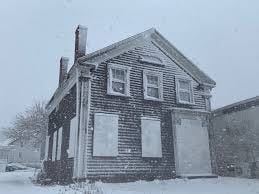
It doesn’t take much to heave my mind back to Martha’s Vineyard, especially when there is a Jewish angle involved, as there was when I read this post on Rabbi Tzvi’s Substack:

Five Corners. My old neighbourhood. This unexpected trip down memory lane led me back to Cromwell Lane, fifty yards up Beach Street from Five Corners, and the first home I had on Martha’s Vineyard, the “Caleb Prouty” house. We didn’t last long at that house because it turned out to be haunted.
It’s funny, but it’s not the memory of our old house that haunts me. It’s the memory of two other houses—one at the end of Cromwell Lane, on the corner of Beach Street, across from what is now Cumberland Farms: the other across Beach Street, heading up towards Main Street, just past the old Fire Station. Those two houses, I now see, formed the twin pillars at the entrance to the temple of my life story. For fifty years I held them apart in my mind—never once connecting them. How strange that seems to me now. Those houses stood less than thirty yards apart, and the thoughts they stir are so deeply intertwined within me that I can’t fathom how I missed the link between them until now.
I, who have spent years chasing every Jewish thread on Martha’s Vineyard—hunting for a single event, a face, a moment I could crown as the origin of the path that led me here: a Zionist Orthodox Jew living in Israel.
I’ve been writing on Substack for three years, with a long queue of autobiographical drafts still waiting. Yet somehow, I found myself leaning back in my thinking chair, startled by two questions I’d never thought to ask:
Who was the first Jew I ever met?
Who was the first Jew-hater I ever met?
I expected a long, winding stroll down memory lane. Instead, I was suddenly hovering in my mind’s eye over the Caleb Prouty house—and like watching an animated Civil War map, I saw two cannonballs strike: one at the house on Cromwell Lane, the other nearby across Beach Street.
A clear and final revelation:
The first Jew I ever met lived in the house at the end of Cromwell Lane.
The first Jew-hater I ever met lived in the house on Beach Street.
We moved to Martha’s Vineyard in the summer of 1963. I was seven, about to start second grade. The moment the last moving box hit the floor of our new house on Cromwell Lane, I bolted out to explore. I was in Heaven. Main Street—its shops, its movie palace, The Capawok—was one minute away. At the head of the A&P parking lot, the Tisbury Police Station glinted like a promise of action.
I was wrong about the action. Vineyard Haven was a sleepy town: drunk drivers, shouting spouses, nothing more. Little did I know then that thirteen years later I’d be in that same station’s uniform—a “summer cop” between college semesters—waving ferries in, heart racing through a season of chaos:
An FBI Ten Most Wanted fugitive, cuffed on the dock.
A standoff with Hell’s Angels, engines snarling.
A botched bank robbery, sirens screaming.
And to top off that summer in uniform, on a quiet afternoon in my final week, during a lull between boats, I noticed an elderly woman watching me from across the street. She approached me with purpose, stopped inches away, and locked eyes.
“You are going to have much to write about.”
I flushed crimson, grinned, wondering how could she know, and said: “You have no idea.”
“Yes I do,” she replied, a knowing glint in her eye.
I blushed harder because I recognized her—Lillian Hellman—and saw she was pleased I did.
Across Beach Street, as if an extension of Cromwell Lane, a narrow sidewalk led to Memorial Park. Back then, before wetlands were sacred, the park was half swamp, half miracle: two baseball diamonds, a cracked basketball court, two swings, and a wide flat field where the Regional High School played football—no bleachers, just a ring of bodies around the edge on game day.
That first summer, and every afternoon after school started, I drifted to the park. I walked the perimeter, dreaming of the day I’d be big enough to play football. At first, I wasn’t allowed at the Saturday games. I’d stand at the end of Cromwell Lane, straining to see past the crowd, catching only the thud of bodies, the roar of voices, and if the wind was right, a whiff of crushed grass and sweat.
Sports fields are for brotherhood. Here, in the all-American crucible of pads and whistles, boys were forged into men, and into that forging, the ancient hate slipped in.
Quiet.
As if inevitable.
Splicing itself into our young souls like a shadow no one could name.
This field, Memorial Park, where I imagined my future glory, became the unholy bridge between the two houses, between the house of the Jew, and the house of the Jew hater, the point where the wings of antagonistic Cherubim met.
According to my calculations, I was seven years old when I encountered my first Jew. Jews actually. As I have said, whenever I could I made my way to Memorial Park. Crossing Beach Street was a dangerous prospect. For a driver coming up Beach Street from five corners there was no way to see if someone was about to emerge from Cromwell Lane, because the hedges in front of the little house at the end of the lane obscured the point where the lane intersected Beach Street. I would come to a stop even before reaching the end of the lane, and ease up to the intersection, looking both ways, twice. Sometime in the late summer of nineteen sixty-three, I paused before crossing Beach Street and perchance looked to my left, my head peeking just above the newly trimmed hedge line. Sitting in the sun in their closed-in little yard were two old ladies. They were not looking at me, rather, they looked at each other, unsmiling and motionless. Until that day, I had only seen the hedge next to me, and my mind was always on the dangers of Beach Street. Their sudden appearance surprised me and I reacted instinctively, good boy that I was. I piped a cheerful “Hello,” with a friendly wave. In my limited experience as a child amongst adults, such a greeting had never failed to elicit a friendly response. In this case I was completely ignored. Thinking that they had not heard me I repeated my greeting, louder this time. Their heads did not move but I thought that they had moved their eyes in my direction. This signalled to me, young as I was, that their lack of reaction was born of fear. It reminded me of my younger brother playing quietly and contentedly with a new toy as I walked into the room. At that point his sole purpose in life was to make himself invisible. Anything so as not to draw my attention, and specifically not to display that he was enjoying himself. Instinctively, with my little mind churning at their unexpected fear of me, and minor bully that I was, I used the closest tool at hand to react--I stuck my tongue out at them. They did not seem to react. They still looked at me without turning towards me. Two eyes were looking at me, but from different bodies. Something in me combined the two eyes as if they belonged to a single splayed-out face, and once I imagined this flat-faced relief like some ancient Egyptian stele it was clear to me. They had noticed my impudence.
I was dumbfounded, and embarrassed. I ran home and told my mother what had happened, leaving out the part about the tongue. I was expecting some kind of fallout. A young boy does not stick his tongue out at grownups. I was preparing the stage, so that when the fallout did come my punishment might be mitigated somewhat by my confusion over their refusal to say hello back to me. I saw that I had managed to confuse my mother also, which further confused me. My mother said nothing. My father, who had been in the living room and heard what I had said, came into the kitchen, and with a knowing smile said: “Oh. So you’ve met the Mengele twins.” My mother gave him a sharp look, but he pushed on, as if enjoying the texture of the term as it rolled out of his mouth, and as such I listened closely, trying to connect. The Bobbsey Twins novels that my sister read. The Minnesota Twins of Major League Baseball. Now, the mysterious Mengele Twins.
My mother knew where this was going. “He’s too young for that,” she said.
A parent’s desire to preserve childhood innocence. My mother was all for it. My father was not. For him, if I was old enough to walk by myself to Memorial Park, I was old enough to hear about Josef Mengele. Hear I did, but what I heard made absolutely no sense to me.
“Mengele was an evil Nazi doctor who experimented on Jews before having them murdered,” he said.
That was enough for my mother, and she gave him one last look before leaving the kitchen, where I remained with my father.
I knew by then that the Nazis, along with the Japs, had been our enemies in World War Two, but to my young mind, “Doctor” was the inverse of “evil.” Doctors were supposed to operate on humans. That is how they were healed. What did he mean by experimenting on them? Who were the Jews?
“How can a doctor be evil?” I asked.
“Oh, in the same way that anyone can be evil. By doing evil things.”
I paused.
“What did he do to them?” I asked, meaning the twins on the corner, already afraid of the answer.
My father did not hesitate. “He removed muscles from their arms and legs to see if they could function without them. And from their faces. That is why they cannot make facial expressions. They were not being rude to you; they simply cannot smile.”
I had never heard anything like that before. What was this revelation? I looked at my father for comfort, but none was there. I could not hold back my tears, and I ran to my mother where she sat in the living room. She held me for a while as I sobbed. My father stood at the doorway. I could not look at him, but I knew that they wanted to talk so I climbed the stairs to my bedroom. In my bed, I could hear them talking. I heard my father make some forceful points and to my surprise, I heard my mother answering him sharply. This was not like her. But later, when I came back down for supper, the subject did not come up again. There was an agreement between them, and I was left to deal by myself with the demons that had been aroused.
My imagination could not take me far towards the reality of the Holocaust. I had those cryptic words of my father and my own real encounter with the silent and immobile twins—the Mengele Twins—with which to construct a childish framework of understanding. As a result, in my dreams they became twin wicked witches of the West. Or not. Alternately they were good witches of the East, silenced and frozen under a spell thrown upon them by the evil witch of the West, and as such, maybe there was an assignment for me to rescue them. But somehow, I knew that in my dreams as in real life that they were beyond rescuing; they were as rescued as they ever could be. They lived with that, motionless, silent, sitting in their enclosed yard with a compassionate sun on their faces, unsupported flaps of skin on their arms and faces caressed by the gentle island breeze. That was as good as it could be for them.
With this “framework of understanding” I continued with my daily walks to Memorial Park, though now not looking in the twins’ direction, only slightly raising my hand in a perfunctory welcome, not caring whether they acknowledged it or not. It was like kissing an anti-mezuza on the way out the door, a way of giving thanks for forgetfulness, instead of for remembrance. And I did forget, or at least compartmentalized: those unfortunate twins were Jews, something different from me. It would be another five years before my father took it upon himself to tell me about the Jews.
I began to spend more time with the new friends I had made at school so that my trips to the park became much less frequent, and at some point, in the late fall when the first hints of the winter chill became evident, I noticed that the twins were not in their yard. I imagined them on their broomsticks flying south for the winter but sensed that they were probably just sitting inside the house, keeping warm. I had been keeping track of them after all, scanning their yard with the corner of my eye. They were not forgotten so easily.
Now that I was relieved of their physical presence I felt a new freedom. They were not on my conscience anymore. This seemed to me proper at the time. Theirs was an issue for grown-ups. I was just a boy. The relief that I felt was reflected in those grey Sunday afternoons after the end of the football season, walking into the park where my imagination would now lay softly, flattened on that field of play as if hibernating, or resting after the big battle, the final game of the season against Nantucket.
Winter came, and I would go to the park once a week, on Sunday, after church and dinner. One Saturday night, snow began falling. I could not sleep. Finally, I went downstairs and found my father reading in the living room. I asked him if I could go outside. He smiled and said yes but told me not to go too far. As I donned my winter coat, hat and galoshes, I was in a state of wonderment, as it was clear that it had been left up to me to decide what was too far. I took my first step in the snow and stopped to stand, like Neil Armstrong on the moon later that decade. True, I was a child in the moment, enjoying the magic of fresh fallen snow, but when I began to move in the familiar direction, I felt as if I were representing something, someone. I enjoyed every step towards the twins’ house, my rubbery footdrops the only sound until I reached a perch at the corner of their lot from where I could see most of their little yard. And as I stood in the dark silence, seeing the clean white slate of their yard, I felt as if my slate had been cleaned too; I was no longer culpable. I need not hold them in my mind any longer.
The snow continued to fall that night. The next day, after Sunday dinner, I set off for the park. The trudge of my galoshes belied the lightness of my being as I traipsed along in a dance of thanks to the heavens for sending this cleansing white coat that covered my world, inside and out. I was thinking of the snowman that I would build in the park. Approaching the twins’ house I felt no need to look in their yard; the previous night-visit had purged me of that need. And free of the need, I of course looked over towards their yard. I froze where I stood.
There was a single four-paned window on the side of the house, and in the bottom two panes, facing each other as if from a folded piece of paper in art class assiduously scissored and opened to reveal a mirror image snowflake pattern, the twins were looking at me, as usual, through one eye each. My only thought, having been cleansed, was why do they not turn to look at me full faced? The answer to that question entered my mind with the force of a blizzard. There must be something, sunken, pock-marked, torn and scarred on the far sides of their faces like the unseen craters on the far side of the moon. Now I was crazed with fear and felt violated. Though it was I who had turned to look, once again, towards the unfathomable twins of Mengele, and had found them recessed within a small square portal of clarity when I had thought that they had been blurred-out forever, still, something beamed out at me through that glass like a bank of spotlights being turned-on on a playing field for a night game. My young mind could only flinch, but even so there was a basic comprehension that disturbed me and hurt me. The basic fact of the twins being there—of their being at all—was an affront to me. I stood there with a healthy and powerful anger that I had not known until then. I was so invigorated that I could have led a Crusade. Young boy that I was, my crusade could only take me on to the park. There I could play out a resolution to the twisted thoughts in my mind which I now understood to be unfairly caused by the twisted and contorted bodies of the twins.
Thus, determined to fight my righteous fight, I began to turn towards the park and as I took my first step, I detected in the corner of my eye some movement in the window. Ecstatic inertia enabled me to carry on with a few more powerful steps ignoring what I had just barely seen, but even before reaching Beach Street I had absorbed what had glanced off my left eye—me seeing it as they saw the world, through one eye. I had seen two hands raised in greeting. Now running, ploughing forward at the same time knowing that I should turn back and return the greeting, I reached the park. My carpet of certainty had been pulled out from under me and all that was left was the snow-covered expanse before me. It was a clean slate again but this time it was demanding. I spoke to myself in a whisper:
“How could I have thought such a thing? How could I have thought such a thing?”
If asked, I could not have explained the “thing” that I had been thinking. It was beyond me, but I knew that I had turned a corner and had entered a space of darkness, and I now was confounded by this totally unexpected gesture of theirs—that had been so absent a few months earlier—that had pulled me back from the abyss. A hand raised in greeting and a young boy’s heart demolished in return. Everything was upside-down and I knew that it was because I had allowed myself to be drawn into a dark space, because that had been the easy thing to do. I turned my head, looking for an escape that I knew not to be there and saw something that lifted my spirits. There was a huge snow drift against the retaining wall behind the fire station. A boy could dig a tunnel there.
Directly I was on my knees digging. I was a boy again, demanding my fun. There was no danger because the snow was light and fluffy. Had it collapsed on me I could have stood up and punched my way out. But digging down below I was surprised how dark it became so soon. I had dug a little over a yard and all I could hear was the sound of my efforts, and all I could see was an increasing darkness. Then, somewhere in the middle of the drift I changed my direction and turned to the left. If I continued in this direction I would quickly break out back into the park, but once my torso was in the new section I stopped digging. There was quiet. There was darkness. There was cold. And there was restfulness. Surprised, I lay my head sideways on the crook of my arm and enjoyed the emptiness. Had I outrun my demons, demons that had no place in the mind of a young boy? Was this all-engulfing darkness and silence a cleaner slate than a virgin field of snow? It wasn’t long before the cold began to seep in through my pants. My body began to shiver and with it the inner silence that had been so comforting departed my young soul like snow rising upwards and with that lifting the blizzard of emotions fell back upon me and I became afraid of my tunnel—my mock grave. I quickly backed out and stood up and revelled in the light, that special light that hovers over a field of snow, white, clean, and pure.
I turned to walk towards home and as soon as I did my fear disappeared. I crossed Beach Steet and though I could not bring myself to look towards the House of the Mengele Twins, I did raise up my right arm in greeting, as high as I could reach. I entered the house, removed my galoshes and winter coat and told my parents: “Those twins said ‘Hi’ to me.” I did not make eye-contact with my parents but did pause to allow them to say something. I think that my father would have had something to say but his truce with my mother was too fresh. I continued to my room, feeling some kind of victory, though I could not express over what precisely that victory was, but I had stood up to…something, I had endured a test, and had proven myself. When I reached my room, my mind was not on torture and Jews and darkness and death. Standing in my room looking out my window over the roof of the A&P where I could see the ferry slip, I knew that I would be a football player. I knew that I would pass muster. As it turned out, I was looking in the right direction for those thoughts, because ten years later our victorious high school team would return from away-games late at night on the ferry, and if it had been a significant victory, we would be met by large cheering crowds of well-wishers, and a police siren or two. After the ferry had juggled itself into the slip and the lashing chains had been cranked tight, we would walk down the loading ramp and be engulfed by the public tribute.
That night, when I lay down in my bed, for the first time in my life I felt that I was the Master of Myself. I knew that I was still a boy, but I felt that I had matured in a significant manner. I felt more grown-up. The rest that I was about to have was a well-earned rest, not yet the rest of a warrior after battle, but still a deserved sleep. And on that very night, I learned that there is little correspondence between what you think you deserve and what you eventually receive.
My mother’s scream tore through the house. As if commanded, my sister, brother and I stood at attention at the threshold of our rooms, looking, listening, afraid to approach our parents’ room without permission. I, newly Master of Myself, turned out to be not a master of my bladder as I had wet my pants from fear, from the shock of hearing my mother scream. My sister, brother and I looked at each other but said nothing while holding back our tears. For years, that had been the extent of my memory of the event. The strongest memory was the embarrassment I felt at having wet my pants, and the tremendous relief I felt when I noticed that my younger brother had wet his too.
Many years later I was visiting from Israel and my mother and I sat on her porch, comfortable with each other, and the memory popped into my head.
“Mom, that time back on Cromwell Lane. Did you really see a ghost?” Here is what she told me:
She was asleep in her bed when someone leaned down next to her and whispered something in her ear. She woke up, thinking that it was her sister-in-law Twinky Carr—my father’s twin sister—who was visiting at the time. Now awake, she heard another whisper in her ear: “I have something to tell you.” At that point she knew it was not Twinky, and she looked. It was a ghost in the shape of an old grey woman. Then my mother screamed, the ghost disappeared, and my father jumped up out of bed. Instead of comforting my mother, my father was leaning over her as the ghost had done, and shouted over her screams: “What did it say? What did it say?” My mother remembered being so angry at him that the fear of the ghost faded. She shouted at my father: “She didn’t say anything! I screamed. She disappeared!” My father said: “Why didn’t you wait to hear what she said?”
At the sound of the commotion, my aunt Twinky had run to my parents’ room to be at my mother’s side to calm her, while holding her twin brother—my father—off. She was the perfect intermediary. My father stood in the corner of their room, fuming. As my mother told me this I thought of my father. I knew exactly what was in his mind. A father is like a twin, at a distance in time. He was thinking that in the rare event that a ghost wants to tell you something, it could only be about buried treasure and if you want to get to the treasure you have to let the ghost speak. It was as if my father was saying, at the moment when my mother was in her deepest distress, when she most needed comforting: “How could you be so stupid?” while believing that he was right in saying so. His thinking was that my mother would have benefited from the buried treasure too. In yelling at her he was educating her. That was it: she needed educating in the ways of ghosts. I understood my father because I too became just such an educator for a time, I am ashamed to admit.
My mother gazed off towards the tree line and repeated the quote to herself “How could you be so stupid.” She turned back to me and asked:
“What do you think? Should I have waited to hear what the ghost had to say?”
It was an innocent question, but it carried with it the weight of another, unspoken question: Would you have reacted like your father?
“No Mom. You were right to scream. If I had been by your side I would have held you tight,” I answered without hesitation, the veteran of many hugs of my shivering wife—and children—giving freely of what is sometimes the only thing that we can give. To hold another soul steady against the darkness.
My mother went silent. As for me, lost memories returned. I remembered.
We three children stood in the doorways of our rooms. We looked at each other. The hallway was not heated so we began to shiver. I was relieved to see that my younger brother had also wet his pyjamas. I was never one to leave a silent moment at peace, and I said to my brother and sister: “Mom saw a ghost.” I did not know that. My sister managed to say: “There’s no such thing as ghosts,” before she and my brother began crying loudly. At the sound of their crying Twinky burst out of my parents’ room, took a quick look at me now standing there calmly as if paring my nails, then continued down the hall to my siblings. I heard: “Billy said that Mommy saw a ghost!”
“Nonsense!” Twinky said, huddling them back to their beds. “Mommy just had a bad dream, that’s all.” I waited as she put them back to bed. I knew what was coming.
“Why did you say that? Look what you did to your brother and sister. They are terrified,” Twinky said.
“Because she did.”
“How do you know that?”
“Because I saw her too.”
Up until then, my aunt must have thought that I had heard bits and pieces of what had transpired in my parents’ bedroom. But by saying “her,” authoritatively, I had given my aunt pause. How could I have known that the ghost was a “she?” My aunt thought for a moment and then called for my father. I saw how they worked together—they seemed to be closer than my father was with my mother. Twins are like living ghosts of each other.
Alone in my room with my father, I already knew what I was going to say. I had not seen the ghost, of course, but the moment that I had told Twinky that I had, a kind of ghost did appear to me. It was the ghost of an unfinished conversation. It conjured itself up into my consciousness and there was a substance to it that was like a whispery presence on the stairwell next to my room, seen out of the corner of an eye.
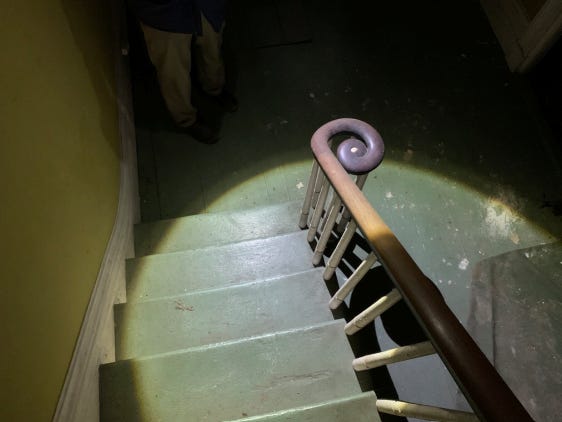
“What did you see?” my father asked.
“It was one of the twins.”
My father paused and looked at me as if he were sizing me up.
“Let’s change your pyjamas and sheets.”
Somewhere in my young mind I realized that there would be few clean slates ahead in my life. Ghosts cling to you like wet pyjamas. For me the Mengele Twins were ghosts—ghosts of a life that had been torn from them with clinical preciseness. As my father tucked me in, I closed my eyes and welcomed all of my ghosts, living and dead and in between, and I dreamed of snow.
Coming Soon:
The Ghosts of Cromwell Lane.
Part two: “Your Jews”
I was so drawn into the story, much like the first time I saw numbers tattooed on the arms of some of my grandparents and parent friend arms while at the old Brighton Beach club in Brooklyn or on one of our trips to Miami as a young child. I was shushed when I asked my parents about it. My father later told me a little about it just to give me a basic understanding. Ahhh childhood. How I miss the not knowing of this evil world we live in .
Great writing, as usual. I find that my children and grandchildren see the Holocaust as part of history. The younger ones (age 3-5+ -), unaware of timeline, will talk about the horrors of Egypt or the Inquisition in the same way they speak about the horrors of ww2.