

For Part One, see here:

Part Two
We moved out of the Caleb Prouty house soon after my mother’s encounter with the ghost. Our new home on North William Street was a serious improvement. There were two lots, one which the house stood on and one with a field adjacent to the street and an apple orchid at its far end. The house had two stories like the Prouty house but was about twice as big. It was as if all the rooms had doubled in size, with the addition of a few extra rooms. This was my home until my second year in high school. These seven years were enchanting. It was a childhood the likes of which I would wish upon all children.
We had evidently moved beyond the range of the Vineyard Haven ghosts. Either that or we were out of favor with them. Regardless, the story of that night echoed amidst our family for years. I remember sitting hidden at the top of the stairs when my parents entertained friends. Once the alcohol had settled in, my father would take center stage and recall the event in exaggerated terms, gesticulating in the air with the hand holding his cigarette as if to fend off some potential ghostly counterattack with his smokey firestick. There was ridicule of my mother, and to my everlasting regret, I was swayed by my father’s stories and learned that the woman by your side needs to be subdued. The women would gather next to my mother with supportive declarations, whether they meant them or not, such as: “I would have screamed. You must have been so scared,” while the men would side with my father, saying: “You definitely have to go for the treasure. You can always sort things out with your wife later.”
One thing that stood out to me was that my part in the episode was not mentioned, and while I felt a certain slight at that, the more important thing was that the last tenuous connection with the twins in my mind was broken. They were forgotten by me until I began writing about them.
The Jews in Tisbury Elementary School in the 1960’s were few and far between, as were the Jews of Martha’s Vineyard. In my class there was one Jew, in the class below there was one, and in the class above there were two. There were several classes without Jews at all. In the Oak Bluffs and Edgartown schools, and the up-island schools, there were no Jews that I remember when all the students of the Vineyard elementary schools reached the single island high school. In the high school there was one Jewish teacher. In Tisbury, there was an administrator, the secretary of the principal, who wore her Jewishness with pride. So much so, that she ensured that during the annual Christmas concerts when the school children would sing carols, a Hanukkah tune or two would be included so that the four or five Jewish children would not feel left out. This was remarkable not only because a significant part of the concert was given over to the needs of one percent of the student body, but more so because we all enjoyed singing those songs, and our parents enjoyed listening to them. This was before the upheavals of the late sixties. It was a time when the families of Tisbury Elementary School were comfortable enough in their Christianity to welcome Jews without feeling threatened. Those Hanukkah songs were crowd pleasers and always drew great applause. The Jewish children were warmly accepted by the community and grew up without outward signs of antisemitic animosity. To find antisemitism on the island one had to travel sweetened paths to reach a purveyor of the ancient hatred. My sweetened path led to a football field. To be exact, the sports field of Veteran’s Memorial Park. The first step began in of all places at Grace Episcopal Church.
We were surprised before returning to school for seventh grade when we learned that there would be flag football, and that they were trying to organize a team in Oak Bluffs Elementary School so that we would have someone to play against. This was the first attempt on the island to have organized football before high school. The problem was that Vineyard Haven boys were less athletic and overall softer than the Oak Bluffs boys. We loved football and had our dreams of glory, but we lacked the charismatic breakout players that we thought it took to win games. With few exceptions, we were chubby and slow.
What we did have was a willingness to be coached. We were good boys. We knew how to listen and do what we were told. The fact that a grownup would be willing to take from his own free time to coach us seemed to be a Christ-like sacrifice. We knew that we would be coached by Mr. Glodis, our Junior High science teacher, who had played college football. For us, growing up on far-off Martha’s Vineyard, that was closer to sports royalty than we felt we had a right to be. During the last days of summer, we played in our yards and makeshift fields, wanting to “get in shape” so to be found worthy of being coached. We knew that our attempts at self-coaching were inadequate, but we were willing to go to great lengths to avoid embarrassing ourselves in front of Mr. Glodis. We were open to suggestions.
The suggestion came in the form of an elderly gentleman at our church. He found us milling around together after the main service on a Sunday.
“I heard you boys like football,” he said.
We looked at him, surprised.
“Yes sir, we sure do. Did you play?”
“You could say that. Of course, in my day it was different. All we wore was a piece of leather to protect our heads. None of these girly shoulder pads and such. Back then men were men.”
He had us hooked. All that was left was to slowly reel us in.
“You boys play real football?”
We looked at each other. What was “real” football?
“We try,” someone answered.
“You try,” he repeated to himself, looking away from us as if to search for better specimens. He turned his attention back to us and said in admonishment:
“Sissies try. Real men do.”
Real men. Real football. We wanted that. Then it was agreed that he would coach us, under two conditions:
Those of us who belonged to his church (Grace Episcopal Church) would attend the 8 am service on Sunday. This was not a minor demand. Until then, we had to be shaken awake by a parent to barely make the main Sunday service at 10 am. We liked the idea though, because the 8 am service was quick and to the point. We were outside by 830 am and had the whole day before us.
That we play hard like men. Our coach had no patience for sissies.
And just like that, the tunnel through which we were to run out onto the playing field had as its starting line the reception of the Holy Eucharist at Grace Episcopal Church, early Sunday service. We understood that this spiritual preparation was an essential component of our training. It seemed natural to us. We took our communion seriously and prayed for success at practice. Looking back, for all intents and purposes we were preparing for an Episcopalian Bar Mitzva. This is the precise age when young men need to be regimented and disciplined. This spirit-sports nexus could have easily served the purpose of a rite of passage, were it not for one grave fault.
After services on the first Sunday of the arrangement, we ran home to change into sports clothes. Bending over to tie our shoes was the final genuflection bridging the gap between the holy and the sweaty. We gathered at Memorial Park and waited for Coach. He walked out of the trees that separated his house from the field. He was old and starting to walk gingerly, but his arms were elbows-out like he was ready for a fight. He looked us over with a hard look, and I had a feeling that I might not be ready for “real” football, but I showed no outward fear, though I avoided looking at my friends knowing that they would see the fear in my eyes. Coach didn’t waste any time.
“Gentlemen, we are here to separate the men from the boys. Tell me about your skills.”
Besides Robert Trebby, who could pass and kick the ball, our skills were not developed. The chubby of us played linemen, and the swift ran with the ball. That was about as developed we were at the time. He understood.
“Show me your three-point stance.”
We had a general idea of what he meant, but he said it in such a way that confused us. He intimated that there was a proper way to take a three-point stance. About that we were not sure of ourselves, except Robert, who immediately took the stance will full confidence. We were embarrassed, because the positions Robert would play did not require him to take that position whereas we the chubby ones would spend entire games crouched down waiting for the snap.
“Take the stance!”
We did. We crouched down, leaning on an outstretched arm.
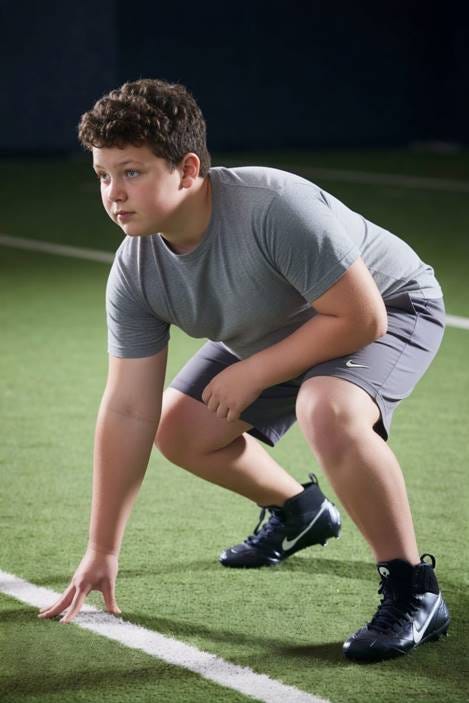
He moved behind us, walking down the line and knocking us over one by one.
“You’ve got to keep your center of gravity lower to the ground, and you have to come out of that stance with speed and power.” He ordered us down again and, passing behind, helped us reach the proper height. It was an unnatural crouch and when we were all adjusted, he said:
“Now hold that position until I say stop.”
Within thirty seconds our haunches were sore and our legs were shaking. One by one we straightened our legs while still in the crouch, our backsides raised awkwardly in the air. This was the pattern that would repeat itself during practice — first knock us down, then build us up. It was an effective system. We instinctively understood that our pain and failings were directing us toward the goal of becoming football players. We learned to revel in it. Because of that, our coach became a larger-than-life figure. We did not worship him, but we listened to him very closely.
After our second practice a week later, he invited us to his house for cold drinks. He entered through the front door and took a few steps inside and turned around to face us as we entered. As we stood there it became apparent that were at the entrance to a shrine. Pictures covered the walls and mysterious parts of unknown machinery were placed on display on the many small tables in the living room. Some were kept in aquarium-like enclosures as if in a museum.
“Have any of you ever heard of Thomas Edison?” he said.
“Sure. He invented the light bulb.”
“He did more than that. He had hundreds of inventions, and I was there to help.”
He motioned towards the pictures, and we stepped closer and saw a younger version of our coach posing alongside Edison in his laboratory.
“In my opinion he was the greatest American who ever lived.”
And with that opening statement, he regaled us with stories of his time with the great inventor. We listened transfixed, because though we had been brought up believing in the American can-do philosophy, here we were witnesses to someone who had taken an active part in one of America’s greatest stories. While talking, he slowly guided us towards his kitchen, where there were a pitcher of ice water and several glass cups. We had been expecting Coke or root-beer, or some other sweetened drink, our thinking being: who invites anyone for a cold drink only to serve tap water with ice? This drawing in of us to his inner sanctum along with his representation of the American story in quasi-religious tones…all of it brought us to unconsciously accept the cold water as a new sacrament of sorts to the god of American ingenuity. We drank and it was like our souls were being cleansed. We coalesced as a team of sorts and were thankful that coach had brought us this far.
I had noticed that coach had filled his cup not with water, but with scotch. Grownups drank, we knew that, but we also knew that the grownups themselves defined drinking as problematical if it was done in the morning. Coach was looking off to the distance, that’s how it seemed, but really, he was staring philosophically at a kitchen cabinet a few yards away. We went silent, understanding that a proclamation was imminent. The proclamation did indeed come, slightly slurred, but with great conviction.
“Men, we have one last practice next week, and it is going to be hard. There will be hard contact.”
He paused, gathering his thoughts.
“If you take one thing from these sessions, here it is. When you wake up in the morning, have a cup of hot water—as hot as you can take it.”
We looked at each other, confused.
“You’ll have a solid excretion. It’ll make your day.”
Now, normally, this was the type of stuff that would crack us up, but it was so far out of left field that we could not react. We were stunned. He wasn’t finished.
“You’ll be plopping logs, believe you me,” raising his glass of scotch as if in a toast to those logs.
We all stood there, wondering to ourselves if there was any way that this scene could turn itself into something positive. I instinctively knew that it was time for me to step up. I had an alcoholic father and understood what was happening.
“Coach, what were some of the obstacles that Edison had to overcome?”
When my friends saw that coach turned to me with admiration in his eyes, they too admired me.
“Come with me back to the living room.”
We shuffled back into the sanctuary, I in the capacity of acolyte of whatever service I had called into being. The others were impressed with my bravery.
“First, you had your competition. Fair competition is good. Unfair competition is bad. That is when ideas are stolen. That can break a lesser man.”
I said: “But he was able to overcome these competitors, right?”
“Mostly, but it was a battle. That’s a shame, because it pulled him away from his innovative work. It was a distraction. Who knows what he would have accomplished without having to deal with such interruptions from lesser men.”
Then, as if it were a natural procession from what he previously said:
“And then, of course, you have your Jews.”
In the moments that followed, it seemed as if he, the alcoholic, had spoken with absolute clarity and after careful consideration, while our undeveloped brains began churning haplessly, unable to process that simple sentence. Here we were, in his Shrine of Edison, coach knowing that he had our attention while giving us the impression that this had been the point of the invitation all along, if not the whole point of the practice sessions themselves.
“Your Jews” meant obviously first and foremost, not his Jews. In the span of one sentence, pronounced with clarity and confidence, we became the proud owners of “our Jews,” whether we wanted to be or not. It was his intention, of course, that we would handle this hot potato by thinking, if not saying: “They are not ‘our’ Jews.” That would be all that was needed to stamp us with that red-hot forge that has tempered the souls of Jew haters through the ages. Just a short, quick profession of faith that the Jews were not of us and that we were not of the Jews. It was an idea that could be developed upon at leisure during the rest of a life. On the defensive, and wanting to be liked by our coach, we remained silent. Except for one of us.
He was on the slow side, and big. The player you put in the middle of the scrum. No complaints. Three-point stance, ready for the next play, he’s there, offensive tackle, standing against the strongest that the opposition can throw at you. A smile on his face. He doesn’t need recognition. He’s there for the rest of the team. His name is Richard. He says:
“I’ve got nothing against the Jews.”
He was a year older than me, but I couldn’t have imagined myself capable of such public sacrilege in this most American Holy of Holies even a hundred years on. Silent disagreement maybe but not taking a principled stand. Not against coach anyway. Not in coach’s sanctuary.
“Oh, you don’t, do you?” It was immediately obvious to all of us that coach, now well into his cups, had not expected resistance, as it was obvious that Richard’s simple statement had turned this secular catechism into a silent debate around a single question: “whose side are you on?”
Not having expected resistance, coach opened the door to see us out, maybe sensing that we had all taken Richard’s side. As we walked out coach said: “Remember. Hard contact next week.” As Richard passed by him coach added: “Especially for you.”
Normally, Richard would be walking home in our group since his home was in the direction of our homes, but farther along on Fairfield Avenue. This Sunday, he walked ahead of us, alone. No one said anything until Robert turned off on Center Street. After separating from us Robert took a few steps and turned around facing us. He said:
“I’m not coming next week.”
This was an even more demanding “choose sides” moment. Robert, our best athlete and uncrowned leader, was expecting a chorus of “me neither’s.” That chorus, if there was one, did not sound a note.
We stood there on the sidewalk, none of us willing to meet anyone else’s eyes. No one spoke. After a moment we began walking again, as if Robert had never said anything at all. We just wanted to play football. Then Robert turned and walked home, along a path that would lead him to convert to Judaism six years later, one of three converts from our graduating class of 1974 at Martha’s Vineyard Regional High School. Robert converted into Reform Judaism, Vincent, our class valedictorian, converted a few years later into Conservative Judaism, and I, after Robert but before Vincent, converted into Orthodox Judaism. Every time I think about the three of us out of a class of less than a hundred souls, I am reminded of the blues tune “One Scotch, One Bourbon, One Beer.” They have since passed on and I imagine them learning Torah together in the Great Beit Midrash in the Sky, saving a seat for me at the table. One day I will take that seat, offer a toast to the lives we led, and proceed to expound upon the obvious superiority of my kind of Judaism. It should be an interesting debate.
During the ensuing week we did not talk about what had happened. Robert was true to his word and did not show up at the next practice session. To everyone’s surprise, Richard did appear. As we stood around on the field waiting for coach, we knew that something had changed. We had lost our spirit. We were still there, going through the motions, hoping to retain something of the original promise of the practice sessions. It was not to be.
Coach came out of the woods onto the practice field. Despite his advanced age, he walked quickly and with determination and with, once he drew close, the smell of alcohol about him. He did not waste time.
“Pair off!”
We did, according to size.
“Take the stance!”
We complied, but it was different now. He was less “coach” than just another mean alcoholic. We all knew the type. However, we so wanted to be coached that we continued to will the situation into a positive one. For the most part we were developing teenagers without the physical form in which to instill the aggressiveness-with-a-pinch-of-cruelty that is needed to be successful at football. Most of us could inflict at most minor bruises and scratches on our fellow teammates. Except for two of our largest players, Richard and David. They were already larger than some grown men, and they were strong. They were also the two friendliest players on the field. It was natural that they paired off together. On that morning, on that field, no-one was planning to hurt, or to be hurt.
“On my whistle, you hit the man opposite you with everything you’ve got, and you do not stop until I whistle again.”
There was no way that we were going to hurt each other, but we had to put on a good show and so when coach blew the whistle, we jumped at each other until we made initial contact and lightly shoved each other and then we let up immediately, standing next to each other and looking at coach. At first, he didn’t say anything. He looked at the ground as if disgusted. He paused, as if waiting for some chemical process to finish.
We were breathing heavily. We had held back from hard contact with our friend opposite, but still, going through the motions, we knew that more was expected of us and had made initial contact and shoved a little harder than we had up until then when playing touch football. I had been surprised that the boy I was paired with, smaller than I, had hit me harder than I had hit him. It was a wake-up call, and the chemicals flowing in our veins brought to us new feelings that we had not known before. In one sense nothing had changed: what drove us still was a desire for the approval, if not the praise, of coach.
“If you are afraid of physical contact just let me know,” coach said. “I’ve got better things to do than babysitting for a bunch of sissies.”
Nobody moved, nobody said anything. We waited for instructions on how to redeem ourselves. They came soon enough.
“Mr. Clark, take the stance,” coach said, using Richard’s surname. “Mr. Honey, take the stance facing him.”
The rest of us felt relief that we had not been called upon. We were eager, but not that eager. The relief I felt was short lived.
“Mr. Luce. Line up beside Mr. Honey.” Coach continued. “Gentlemen, this is where we separate the men from the boys. You are going to be double-teamed sometime in your career. You best be prepared.”
The fact of the matter was that Richard and David were our two strongest boys, evenly matched, and my part in this exercise made little sense. They were like two lions vying over control of the pride and I was the cub off to the side, frightened, but play-acting as if I belonged in the fight.
“Set! Hike!”
Richard and David smashed together with full force. I was barely out of my stance when their entanglement drifted towards me and with a mighty final exertion, they sent me flying on my backside. Richard smiled at me and reached down to help me up, but I rolled over on my own and stood. Something had happened. Richard and David were standing side by side next to coach, breathing heavily, but we could see on their faces that they knew—as we all knew at that moment—that they had passed the test. They had crossed the divide. They showed us how it was done. Coach had been correct. On their side stood football players, men, and on our side stood the play-acting lion cubs, the boys. We too wanted more than anything to cross that divide. But since most of the boys besides Richard and David were my size or smaller, and in the light of my pitiful performance, we wondered how such an outcome could come to be.
“Well done Mr. Honey,” coach said, pointedly leaving out mentioning Richard. “Mr. Luce, do you want another shot at this, or are you content to be a sissie?”
The appearance of this mean streak aimed at me specifically was an unexpected turn of events. My face flushed with embarrassment again and I was beyond thinking for myself. I was not going to disappoint coach or myself this time around. There was tension in the air. I wanted to cross the divide. I wanted to be a football player. David and Richard faced off with what was apparent to all mutual respect. The respect of warriors. I was trying to hide my fear. The natural fear of physical contact and the greater fear that permeated my sole: of failing at the task and making of myself a laughingstock. Coach approached me and everyone, on both sides of the divide, understood that what he was about to say to me would hold some wisdom that would help us overcome our fear so that we all would be football players. If that were not enough, coach pulled David away, leaving me to face Richard on my own.
Coached put his arm around my shoulder and said, as if it were the most valuable piece of wisdom that he could impart upon us:
“Are you going to let this Jew-lover beat you?”
I looked at Richard and saw disgust in his face, but I was already shaking my head no, I wasn’t going to let that happen.
“Take the stance!”
I was alone against Richard. On the previous exercise with David on my side, I ended up on my butt. I did not expect to win this joust against Richard, but I was determined not to end up on the ground.
“Set! Hike!”
Richard, the strongest of us, and the gentlest, just stood up in a crouch to absorb whatever I would manage to throw at him. I was huffing and puffing like the little engine that could, ready to explode into this, this Jew Lover. I was full of sound and fury, but still, fear overcame me and I barely made contact but when I saw that Richard had not been expecting much from me and actually seemed totally relaxed I fell into an rage and brought my right elbow up into his face and made solid contact, well after the exercise was over. I threw that elbow as an afterthought, totally disconnected from football. Richard covered his face with his two hands and walked off to the side.
“Good hit, Mr. Luce.”
There it was, finally: praise from coach. I wanted to feel triumphant, but Richard turned to me, blood between his teeth and dripping from his nose and said:
“Oh, real good hit ‘Mr. Luce’. You’re the big hero.”
Coach seemed satisfied. Richard’s bloodied face was a desired outcome. David was the first to walk away, then Richard, then the rest of us, leaving alcoholic and antisemitic Coach on his own. Richard turned to me as we walked away and said:
“Why are you leaving? You should stay. You belong here with him,” Richard said, pointing to coach.
I had no answer for him, and I could not even mouth an apology. I turned away and took a different direction — one that led me past the white wall where I had once built my snow tunnel and tasted the bitter darkness of the twins’ fate.
Here too I wanted to escape. But there was no snow now. Only inner snow settling on my brain to cool the shame, to hide the cruelty and aggression that was now part of me and would remain crouched, ready to pounce whenever a ball was hiked in my future.
These memories startled me. At the time, I had not remembered the twins at all — even though, from the small front porch of coach’s house, a slight turn to the left would have revealed the very same garden and window through which I had once seen their ghostly presence projected. Fifty yards and six years separated the two houses and the two pivotal events.
I have no idea whether the twins were still alive to see us entering the Shrine of Edison. They may have been. I wonder if coach, before stepping inside, would sometimes glance toward their home with a wry smile, feeling that justice had finally been done to “your Jews” over there. If they were outside, perhaps he even waved. Who knows.
I wonder, too, whether they ever saw me and recognized me — as I was drawn into the same realm of hatred that has polluted the world from time immemorial.
Mostly though, I was startled by Richard Clark’s principled stand, as I am today at Gentiles who stand with Israel. How could one so young take such a stance? I have my thoughts about it.
Richard’s father, Richard senior, worked for one of the few Jewish owned businesses on Martha’s Vineyard. Brickman’s. He was also a well-regarded volunteer fireman. Those two institutions physically bracketed coach’s house — Brickman’s at the head of Main Street, and the fire station the same distance in the other direction, right across from Cromwell Lane.
Richard’s simple statement, brave and surprising as it was, could not account for coach’s targeted attack against him. Richard was serving as a double proxy: on one side standing in for coach’s hated Jew, and on the other side standing in for whom? His father? Did Richard Senior take a job that coach had wanted? Or was Richard Senior the prime Jew-lover in coach’s eyes, his work contributing to sustaining a Jewish presence in town?
But it could be more than that. I remember that soon after we arrived on the Vineyard, the Clarks, originally Catholic, joined the Episcopal Church. Some Protestants did carry a hate for Catholics. Maybe that is what irked Coach — this Johnny-come-lately Episcopalian who probably still had a warm place in his heart for a foreign prelate sitting in Rome.
In the end, antisemitism comes from whence it comes, and our memories come from whence they come, and are what we make of them. I look back and see that Mr. Clark’s employment at Brickman’s was an American success story. His steady work ethic and loyalty to his Jewish employer was rewarded with long-term employment and loyalty in return. That steadiness, that steadfastness, made for an even greater American story when Mr. Clark partnered with a friend and they began to develop a parcel of land beyond Farfield Avenue. They would work on weekends, doing the building themselves, and at some point, they had built an entire neighborhood. That industriousness probably put the Clark kids through college.
But this American success story does not stop there.
Few things reflect the spirit of America more than the volunteer fire department. These volunteers, on-call 24/7, spend hours upon hours training and on the upkeep of their equipment. So now, in my memory, Mr. Clark stands astride the house of hate like a latter-day Paul Bunyan — one foot at Brickman’s and the other at the fire department, quick to smile and quick to lend a friendly hand, keeping guard over his fair Jewish employers and keeping guard over the twins, those victims of the evil Mengele, making sure that no fire of Jew-hatred can ever catch hold on his beloved Martha’s Vineyard.
Brilliant storytelling, as usual.
I thought I new all or your stories. It seems you withheld your best from me for 48 years. Actually it keeps my interest in our friendship. There's more to the iceberg to discover.